Introduction
The global financial services industry operates in an increasingly complex environment where financial institutions must manage trading activities, market risks, regulatory requirements, and operational processes with accuracy and efficiency. As banks, investment firms, and financial institutions continue to modernize their technology infrastructure, integrated capital markets platforms have become essential for managing financial operations.
One of the prominent platforms used in this environment is Murex, a technology solution designed to support trading, treasury operations, risk management, and post-trade processing.
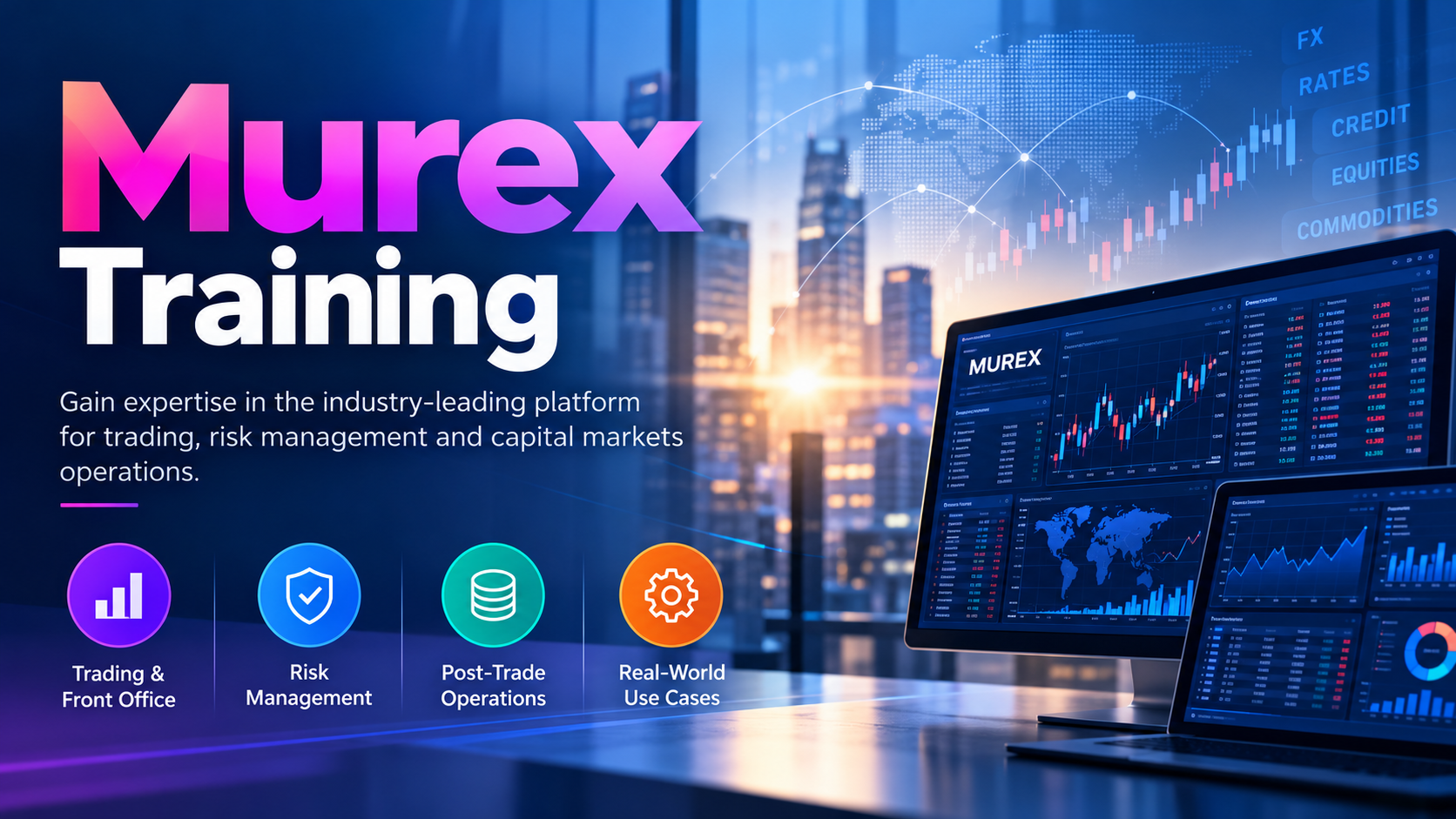
Murex Training helps professionals understand the functional and technical capabilities of the Murex platform, particularly its MX.3 solution. It introduces learners to financial instruments, trade lifecycle management, pricing methodologies, risk calculations, operational workflows, and system integration.
For individuals seeking careers in banking technology, financial software implementation, treasury operations, or capital markets consulting, developing Murex expertise can open opportunities in specialized financial technology roles.
This article explores Murex technology, its importance in financial institutions, essential training topics, practical applications, career opportunities, and the value of structured professional learning.
What Is Murex?
Murex is a financial technology company known for developing integrated software solutions for capital markets and financial risk management. Its flagship platform, MX.3, supports financial institutions in managing activities across front-office, middle-office, and back-office functions.
The platform provides capabilities for trading, pricing, risk analysis, collateral management, regulatory processes, and transaction processing.
Financial institutions use Murex to manage different asset classes, including:
-
Foreign exchange and currency derivatives
-
Interest rate products and derivatives
-
Fixed-income securities
-
Equity products and equity derivatives
-
Credit products and credit derivatives
-
Commodities and commodity derivatives
One of the significant advantages of Murex is its integrated architecture, which helps organizations coordinate trading activities and risk management processes across multiple departments.
Instead of relying entirely on disconnected systems, institutions can use MX.3 to support more consistent transaction processing, financial calculations, and operational controls.
Why Is Murex Training Important?
Financial markets generate substantial volumes of transactions, and each trade may involve pricing calculations, risk exposure, settlement requirements, and regulatory obligations.
Managing these activities requires professionals who understand both financial products and the technology supporting them.
Murex Training bridges this knowledge gap by introducing learners to the platform's workflows, configuration concepts, and operational capabilities.
1. Understanding Complex Financial Operations
Financial transactions often involve multiple departments and systems. Murex knowledge helps professionals understand how trades move through the financial lifecycle, from initial execution to final settlement.
2. Supporting Trading and Risk Management
Financial institutions need reliable systems to evaluate market exposure, calculate valuations, and monitor portfolio risks.
Training introduces learners to relevant Murex functionalities and the underlying financial concepts.
3. Developing Specialized Technical Skills
Murex environments require professionals who can support configuration, integration, testing, reporting, and production operations.
Understanding these activities can help technical professionals transition into capital markets technology roles.
4. Preparing for Financial Technology Projects
Banks and financial institutions undertake platform implementation, modernization, and migration initiatives.
Professionals familiar with Murex concepts can contribute to requirements analysis, testing, system integration, and operational support.
Understanding the Murex MX.3 Platform
MX.3 is an integrated capital markets platform designed to support financial institutions across trading, risk, and operational functions.
Its capabilities can be understood through three major operational areas.
Front Office
The front office focuses on trading activities, financial product management, pricing, and position monitoring.
Traders and front-office support professionals use trading platforms to execute transactions, evaluate market conditions, and analyze portfolios.
Relevant Murex training topics include trade capture, product definitions, pricing models, market data, and portfolio analysis.
Middle Office
The middle office is primarily concerned with risk monitoring, trade validation, valuation controls, and exposure analysis.
Professionals working in this area may monitor market risk, analyze profit and loss, and investigate discrepancies between trading and risk calculations.
Murex learning can introduce concepts such as sensitivity analysis, value at risk, stress testing, and risk reporting.
Back Office
The back office manages operational processes following trade execution.
These activities may include trade confirmation, settlement processing, accounting-related workflows, reconciliation, and lifecycle event management.
Understanding back-office processes is particularly useful for professionals working in banking operations, financial systems support, and post-trade technology.
Key Topics Covered in Murex Training
A comprehensive Murex Training program should combine financial market fundamentals with relevant platform concepts and practical workflows.
The exact curriculum depends on whether the training focuses on functional consulting, technical development, risk management, or production support.
Module 1: Introduction to Capital Markets and Murex
Learners begin with the fundamentals of financial markets and the role of integrated trading platforms.
Important topics include financial institutions, trading operations, asset classes, market participants, and the structure of MX.3.
This foundation helps learners understand how the platform fits into financial business operations.
Module 2: Financial Instruments and Product Fundamentals
Financial instruments form the foundation of trading and risk management activities.
This module introduces bonds, foreign exchange transactions, swaps, futures, options, and other derivative products.
Participants examine basic product characteristics, cash flows, pricing factors, and lifecycle events.
Understanding these concepts is essential before exploring platform-specific trade processing.
Module 3: Trade Capture and Trade Lifecycle Management
Trade capture is a fundamental activity in capital markets operations.
Learners explore how transaction details are recorded, validated, amended, and processed throughout their lifecycle.
Topics may include trade booking, transaction attributes, portfolio allocation, lifecycle events, and trade status monitoring.
Practical scenarios help learners understand how trade information flows between operational teams.
Module 4: Market Data and Pricing Concepts
Accurate financial valuations depend on relevant market information.
This module introduces interest rate curves, exchange rates, volatility data, pricing inputs, and valuation methodologies.
Participants explore the relationship between market movements and financial instrument values.
Depending on the training scope, learners may also study pricing configuration concepts and valuation troubleshooting.
Module 5: Risk Management and Analytics
Risk management is one of the important functional areas supported by MX.3.
This module introduces market risk concepts, portfolio exposure, sensitivity measures, stress testing, and risk reporting.
Participants examine how financial institutions evaluate the potential effects of changing market conditions.
Additional topics may include value at risk, profit-and-loss analysis, and risk calculation workflows.
Module 6: Back-Office Operations and Settlement
After execution, trades must pass through several operational stages.
Learners study confirmation processing, settlement instructions, payment workflows, reconciliation, and transaction lifecycle events.
The module also introduces the importance of operational controls and exception management.
These concepts are valuable for professionals supporting treasury operations and post-trade systems.
Module 7: Murex Configuration and System Integration
Financial institutions often customize and integrate their Murex environments to support specific business requirements.
Training may cover configuration principles, data exchange, interfaces, reporting, and integration architecture.
Technical learning paths can also introduce database concepts, SQL, batch processing, and troubleshooting methodologies.
The level of technical depth should reflect the learner's role and prior experience.
Module 8: Testing, Support, and Real-World Scenarios
Testing and production support are important aspects of Murex implementation and maintenance.
Learners explore functional testing, integration testing, defect investigation, issue resolution, and change management.
Case studies may involve trade processing errors, pricing discrepancies, settlement exceptions, or interface failures.
This practical exposure helps learners understand the responsibilities of Murex consultants and support professionals.
Practical Applications of Murex in Financial Institutions
Murex supports a range of financial operations, making its capabilities relevant across banking and capital markets environments.
Treasury management: Financial institutions can use Murex to support treasury trading activities, manage financial positions, and monitor exposures associated with market movements.
Derivatives trading: Derivative products frequently involve complex pricing methodologies and lifecycle events. Murex provides capabilities to support trade processing, valuation, and risk management for different derivative instruments.
Risk monitoring: Risk teams can use relevant MX.3 functionality to evaluate portfolio exposures, analyze sensitivities, and support risk reporting requirements.
Collateral management: Collateral processes are important for managing counterparty exposures. Murex supports collateral-related workflows that can help institutions manage agreements, exposures, and operational requirements.
Post-trade processing: Trade confirmation, settlement, and reconciliation activities are essential for maintaining accurate financial operations. Integrated workflows help institutions coordinate these processes.
Understanding these applications enables learners to connect platform functionality with real business requirements.
Who Should Enroll in Murex Training?
Murex Training is suitable for professionals interested in financial markets, banking technology, and specialized enterprise software.
The program can benefit:
-
Banking and Finance Professionals: Individuals working in treasury, capital markets, financial operations, and risk management.
-
Business Analysts: Professionals involved in financial system requirements, process documentation, and implementation projects.
-
Software Developers: Technical professionals interested in financial application development, interfaces, and system integration.
-
Risk Analysts: Individuals seeking to understand technology supporting financial valuations and risk calculations.
-
Functional Consultants: Professionals working on trading platform implementation, configuration, and operational improvements.
-
Application Support Engineers: IT professionals responsible for monitoring financial applications and resolving production issues.
-
Finance and Technology Graduates: Individuals looking to build foundational knowledge before pursuing specialized capital markets roles.
The appropriate learning path depends on professional experience, financial product knowledge, and career objectives.
Prerequisites for Learning Murex
Murex combines financial concepts with enterprise technology, so some foundational knowledge is beneficial.
For functional training, familiarity with banking operations, financial instruments, or capital markets terminology can help learners understand business scenarios.
Technical participants may benefit from basic knowledge of SQL, databases, application architecture, and software development principles.
Professionals pursuing risk management roles should understand basic financial mathematics, valuation concepts, and risk terminology.
However, beginners can start with introductory capital markets concepts before progressing toward specialized Murex topics.
A structured learning approach is particularly valuable because Murex environments can involve complex configurations and interconnected business processes.
Career Opportunities After Murex Training
Murex knowledge is relevant to specialized roles within financial institutions, consulting companies, and banking technology service providers.
Career opportunities may include the following positions.
Murex Functional Consultant
Functional consultants analyze business requirements and support platform configuration, testing, and implementation activities.
They work closely with trading, treasury, risk, and operations teams to align system functionality with business processes.
Murex Technical Consultant
Technical consultants focus on system integration, configuration-related technical activities, data processing, reporting, and application troubleshooting.
The responsibilities vary according to the institution's architecture and project requirements.
Murex Business Analyst
Business analysts translate financial business requirements into functional specifications and support testing, process improvements, and system changes.
Knowledge of financial products and Murex workflows is particularly useful in this role.
Murex Risk Consultant
Risk consultants work with risk-related platform capabilities, including valuation processes, sensitivities, exposure analysis, and risk reporting.
A strong understanding of financial mathematics and risk management principles is important.
Murex Support Analyst
Support analysts investigate application issues, monitor operational processes, coordinate incident resolution, and help maintain platform reliability.
These roles often require knowledge of trade workflows, system interfaces, and production support practices.
Although Murex expertise can support career development, employment opportunities depend on relevant experience, practical skills, market demand, and employer requirements.
Benefits of Instructor-Led Murex Training
Learning a specialized capital markets platform can be challenging through theoretical study alone.
Instructor-led training offers a structured approach that connects financial concepts with practical business applications.
Experienced trainers can explain complex workflows, demonstrate relevant processes, and help participants understand common implementation challenges.
Scenario-based exercises also encourage learners to analyze problems from both business and technical perspectives.
For example, a trade valuation scenario may require understanding the underlying financial instrument, market data inputs, pricing assumptions, and associated risk calculations.
Similarly, a settlement exception may involve reviewing transaction details, operational workflows, and system interfaces.
These exercises help learners develop analytical skills beyond memorizing platform terminology.
Where authorized training environments are available, practical demonstrations can further support learning. Access to Murex software should be confirmed with the training provider because MX.3 is a proprietary enterprise platform.
How Murex Training Supports Digital Transformation in Banking
Financial institutions are continually investing in technology modernization to improve operational efficiency, strengthen risk controls, and manage evolving business requirements.
Integrated platforms such as MX.3 play an important role in these initiatives.
However, technology modernization requires more than implementing software. Organizations also need professionals who understand financial workflows, system configuration, data quality, and operational dependencies.
Murex-trained professionals can contribute to implementation planning, testing, integration, migration, and ongoing platform support.
They may also participate in initiatives involving process standardization, automation, reporting improvements, and operational risk reduction.
As financial institutions adopt more integrated technology environments, professionals who combine domain knowledge with enterprise platform skills can become valuable contributors to transformation projects.
Why Choose SRJ Root for Murex Training?
SRJ Root offers professional training programs designed to support technical and functional skill development across enterprise technologies.
Murex Training by SRJ Root can help learners develop a structured understanding of capital markets workflows, financial instruments, trading operations, risk management, and relevant platform concepts.
The training approach emphasizes connecting theoretical knowledge with industry-oriented business scenarios.
Participants can benefit from guided learning, discussions of practical use cases, and explanations of important financial technology processes.
Professionals can explore suitable learning paths based on their experience and career interests, whether they are transitioning from banking operations, software development, business analysis, or financial risk management.
Before enrollment, participants should confirm the current course syllabus, delivery format, trainer expertise, software access, and practical exercise arrangements to ensure the program meets their learning objectives.
Frequently Asked Questions About Murex Training
1. What is Murex Training?
Murex Training introduces learners to the functional and technical concepts associated with the Murex MX.3 platform, including trading, financial instruments, risk management, and post-trade processing.
2. Is Murex Training suitable for beginners?
Yes, beginners can start with financial markets fundamentals and introductory Murex concepts. Advanced technical and functional topics may require additional domain knowledge.
3. Does Murex Training require programming knowledge?
Programming knowledge is not essential for every learning path. Functional roles focus more on financial products and business workflows, while technical roles may require SQL, database knowledge, and integration skills.
4. What industries use Murex?
Murex is primarily associated with financial institutions such as banks, investment firms, and other organizations operating in capital markets, treasury, and financial risk management.
5. What is the difference between Murex functional and technical training?
Functional training focuses on financial instruments, business processes, trading workflows, and risk operations. Technical training concentrates on integration, data processing, system configuration, troubleshooting, and application support.
6. Can Murex Training help with career advancement?
Murex knowledge can support career progression in specialized banking technology and consulting roles, particularly when combined with relevant financial domain knowledge and practical experience.
Conclusion
Murex plays an important role in modern capital markets technology by supporting financial trading, risk management, treasury operations, and post-trade processing within an integrated platform.
As financial institutions continue to modernize their technology systems, understanding platforms such as MX.3 can provide valuable professional knowledge for individuals working in banking, finance, and information technology.
Murex Training offers a structured pathway to understanding financial instruments, trade lifecycle processes, pricing concepts, risk analytics, operational workflows, and system integration.
Whether the objective is to become a functional consultant, technical specialist, business analyst, or application support professional, building Murex-related knowledge can provide a foundation for specialized career development.
Explore Murex Training with SRJ Root and develop the financial technology skills needed to navigate complex capital markets environments.