Industrial automation plays an essential role in improving operational efficiency, process stability, and production reliability across modern manufacturing and processing industries. Distributed Control Systems (DCS) enable organizations to monitor, control, and optimize complex industrial processes through integrated automation technologies.
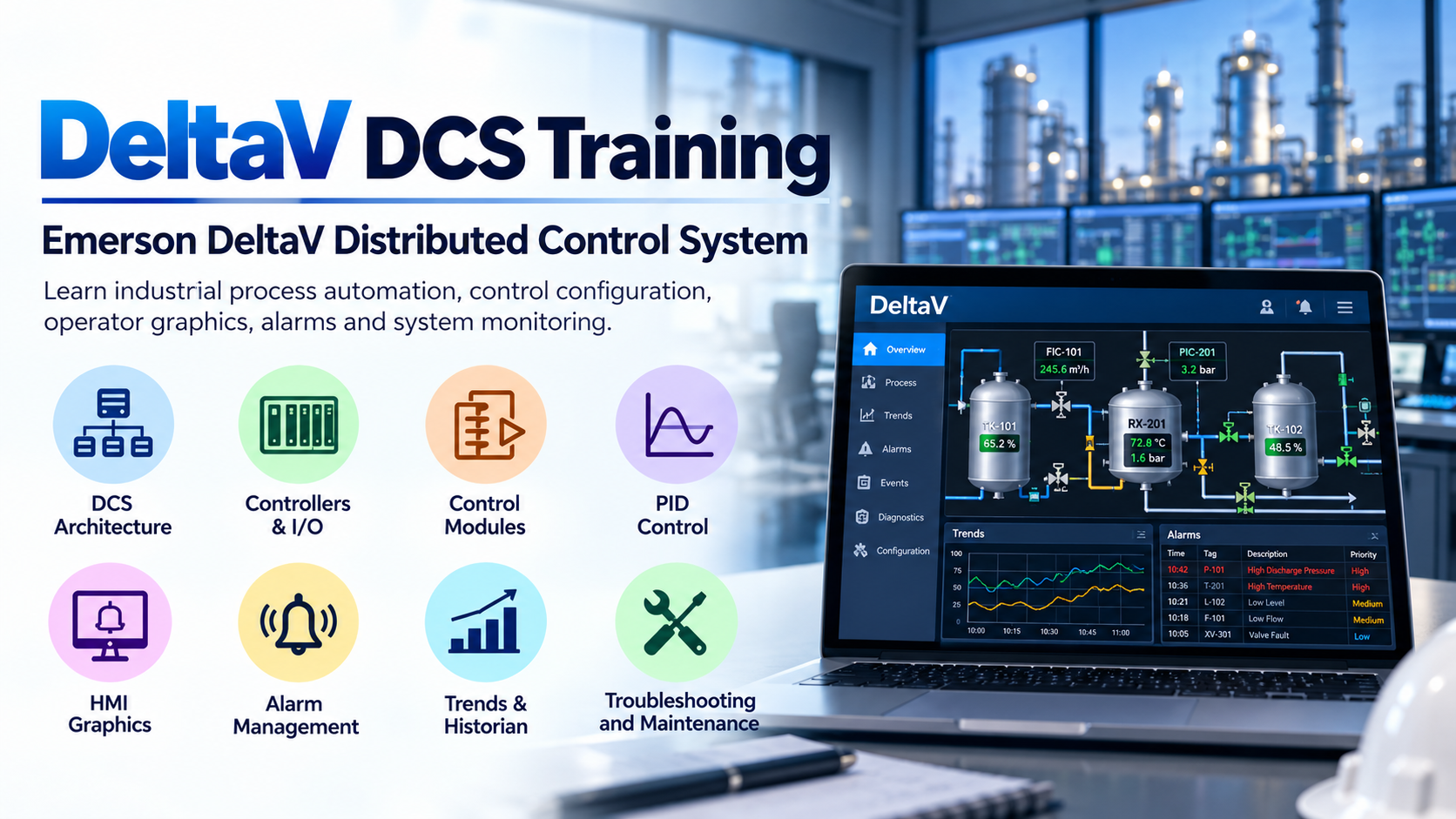
DeltaV DCS Training provides professionals with practical knowledge of Emerson DeltaV Distributed Control System architecture, controller configuration, process control strategies, operator graphics, alarm management, and system diagnostics. The training introduces essential automation concepts alongside practical exercises and industry-relevant process control scenarios.
The program is particularly valuable for engineers and technical professionals working in oil and gas, petrochemical, chemical processing, pharmaceuticals, power generation, and other process industries.
What Is Emerson DeltaV DCS?
Emerson DeltaV is a Distributed Control System designed to automate, monitor, and control industrial processes. It integrates controllers, input/output modules, operator interfaces, engineering tools, and communication networks to support reliable plant operations.
The DeltaV system provides capabilities for continuous process control, sequential operations, alarm management, historical data monitoring, and advanced process automation.
DeltaV is widely applied in process industries where operational consistency, process visibility, and effective control strategies are essential for maintaining productivity and plant performance.
Why Is DeltaV DCS Important in Industrial Automation?
Modern industrial facilities operate complex processes involving multiple instruments, control loops, equipment, and operational parameters. Managing these processes manually can introduce inefficiencies, inconsistencies, and operational risks.
Emerson DeltaV helps organizations coordinate industrial automation activities through centralized monitoring and distributed control capabilities.
Key advantages include:
-
Process Automation: Supports automated monitoring and control of industrial operations.
-
Centralized Monitoring: Provides operators with integrated visibility into plant processes.
-
Control Optimization: Enables the implementation of PID control and advanced control strategies.
-
Alarm Management: Helps operators identify and respond to abnormal process conditions.
-
Operational Reliability: Supports consistent process control and system diagnostics.
-
Historical Data Analysis: Enables the review of process trends and operational performance.
-
System Integration: Facilitates communication between controllers, field instruments, and supported industrial systems.
Key Topics Covered in DeltaV DCS Training
The DeltaV DCS Training curriculum focuses on fundamental and advanced concepts required to understand system configuration, control engineering, monitoring, and troubleshooting.
1. Introduction to Distributed Control Systems
Understand industrial automation fundamentals, DCS architecture, control system components, and the role of Emerson DeltaV in process industries.
2. DeltaV System Architecture
Explore DeltaV workstations, controllers, I/O subsystems, communication networks, system databases, and engineering environments.
3. DeltaV Engineering Environment
Learn to navigate DeltaV engineering tools, understand project structures, manage system configurations, and work with the DeltaV Explorer and Control Studio applications.
4. Controllers and I/O Configuration
Gain knowledge of controller assignments, I/O cards, channels, signal types, device configuration, and field instrument integration.
5. Control Module Configuration
Understand control module structures, function blocks, parameters, module execution, and configuration practices for industrial automation applications.
6. PID Control and Process Control Strategies
Explore proportional, integral, and derivative control concepts, PID loop configuration, cascade control, control logic, and process control tuning fundamentals.
7. Operator Graphics and HMI
Learn the principles of operator interface configuration, graphical displays, process visualization, equipment status indication, and operator interaction with control systems.
8. Alarm and Event Management
Understand alarm configuration, priorities, limits, event monitoring, alarm acknowledgment, and techniques for managing abnormal process conditions.
9. Trends and Historical Data
Explore process trend displays, historical data collection, parameter monitoring, and the interpretation of operational performance information.
10. Sequential Control and Batch Operations
Understand sequential function concepts, equipment modules, phase logic, and batch control fundamentals applicable to supported DeltaV environments.
11. System Diagnostics and Troubleshooting
Gain practical knowledge of controller diagnostics, communication issues, configuration errors, system health monitoring, and troubleshooting procedures.
12. Practical Industrial Automation Scenarios
Apply DeltaV concepts through relevant process control exercises involving tanks, pumps, valves, flow control, pressure regulation, temperature control, and alarm monitoring.
Benefits of DeltaV DCS Training
DeltaV DCS Training helps participants strengthen their understanding of industrial process automation and control system operations.
Key learning benefits include:
-
Understand Emerson DeltaV architecture and system components.
-
Gain exposure to DeltaV Explorer and Control Studio.
-
Learn controller, I/O, and control module configuration.
-
Understand PID control loops and industrial control strategies.
-
Explore operator graphics and process visualization.
-
Learn alarm configuration and historical trend monitoring.
-
Improve troubleshooting and system diagnostic knowledge.
-
Apply automation concepts to practical industrial scenarios.
Who Should Attend DeltaV DCS Training?
The program is suitable for professionals involved in industrial automation, instrumentation, control engineering, and plant operations.
The target audience includes:
-
Instrumentation and Control Engineers
-
DCS Engineers and Technicians
-
Process Control Engineers
-
Automation Engineers
-
Electrical and Electronics Engineers
-
Plant Maintenance Engineers
-
Commissioning Engineers
-
Control System Specialists
-
Process Engineers
-
Industrial Automation Professionals
-
Engineering Graduates Pursuing Automation Careers
Prerequisites for DeltaV DCS Training
A basic understanding of industrial instrumentation, process control fundamentals, electrical signals, and automation concepts is recommended.
Familiarity with sensors, transmitters, control valves, PLCs, or other DCS platforms can be beneficial. However, professionals with limited DeltaV experience can begin with the foundational topics covered in the training.
Career Opportunities After DeltaV DCS Training
Industries that rely on automated process control systems require engineers and technical professionals who understand DCS configuration, monitoring, maintenance, and troubleshooting.
DeltaV DCS knowledge can support career opportunities in roles such as:
-
DeltaV DCS Engineer
-
DCS Configuration Engineer
-
Instrumentation and Control Engineer
-
Process Automation Engineer
-
Control System Engineer
-
DCS Maintenance Engineer
-
Automation Commissioning Engineer
-
Industrial Control System Specialist
Professionals with relevant engineering experience can apply DeltaV knowledge to automation implementation, plant maintenance, system upgrades, commissioning, and process optimization projects.
Applications of DeltaV DCS Across Industries
Oil and Gas Industry
DeltaV supports monitoring and control of processing equipment, pressure, temperature, flow, and other operational parameters in oil and gas facilities.
Chemical and Petrochemical Industry
Used for controlling chemical reactions, mixing operations, material flows, and process conditions.
Pharmaceutical Industry
Supports controlled manufacturing processes, batch operations, process monitoring, and production consistency.
Power Generation Industry
Applied to monitoring and controlling selected power plant processes, auxiliary systems, and operational equipment.
Why Choose Professional DeltaV DCS Training?
Structured DeltaV DCS Training helps professionals connect theoretical automation concepts with practical control system applications. Instructor-led explanations, configuration demonstrations, and industry-focused exercises provide a systematic understanding of DeltaV engineering and operations.
Practical learning scenarios help participants understand how control modules, field instrumentation, operator interfaces, alarms, and process monitoring functions work together in industrial environments.
The program is beneficial for professionals looking to expand their industrial automation expertise and prepare for DeltaV-related engineering and operational responsibilities.
Conclusion
Emerson DeltaV DCS is an important industrial automation platform used to monitor, control, and manage complex process operations across multiple industries. Understanding its architecture, engineering environment, control strategies, and diagnostic capabilities is valuable for professionals working with industrial control systems.
DeltaV DCS Training provides structured exposure to controller configuration, I/O management, PID control, operator graphics, alarm management, historical data, and troubleshooting. Through practical exercises and industry-relevant scenarios, participants can strengthen their technical knowledge and prepare for specialized responsibilities in process automation and control engineering.